
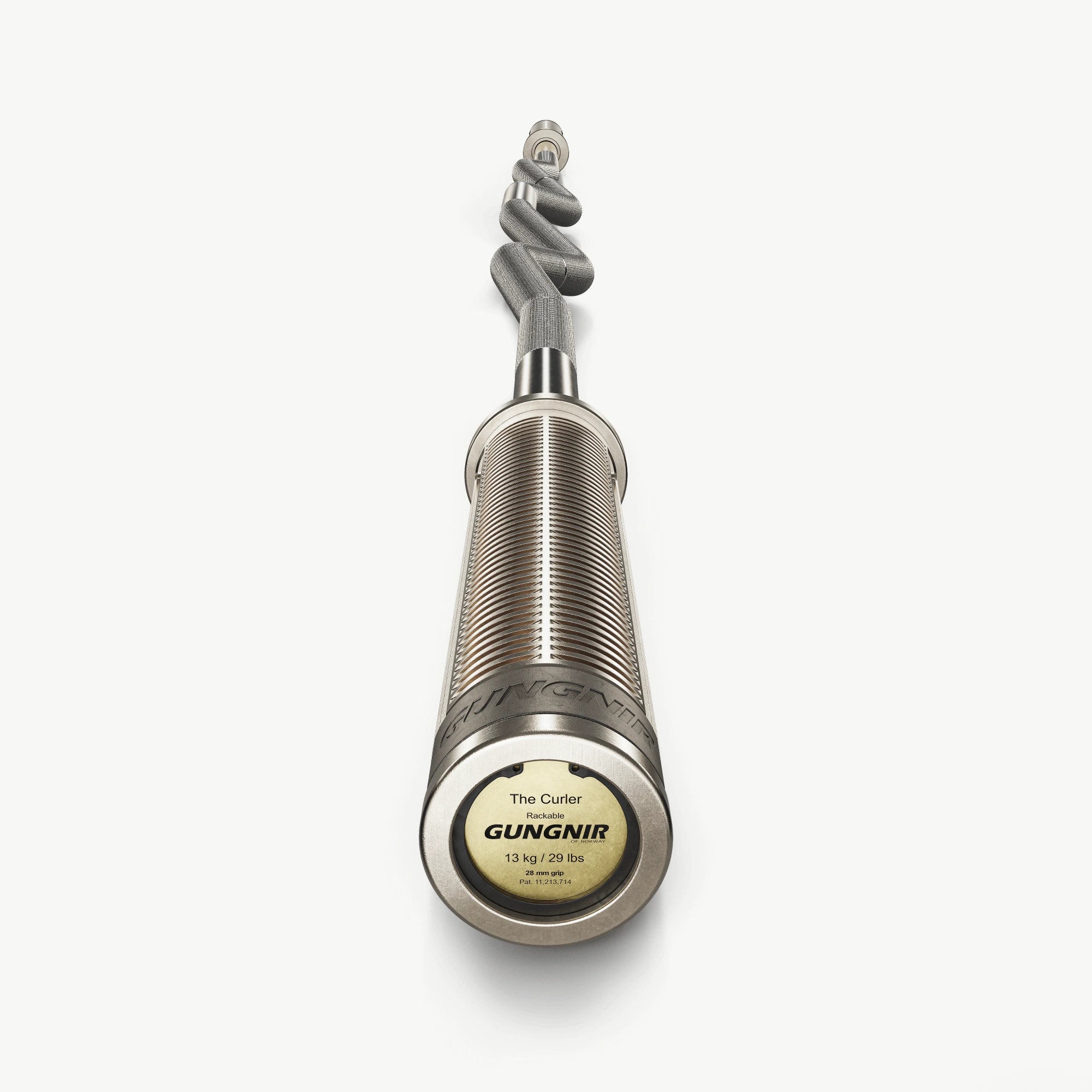
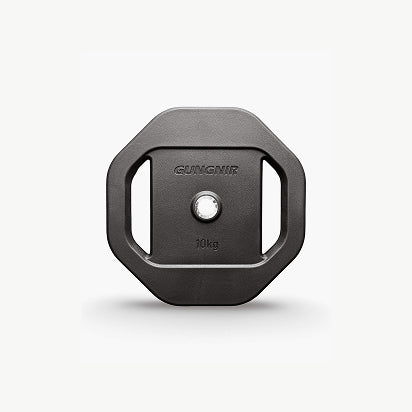

In a collar-free gym every barbell has its collars built in, so there are no clips to look for, lose or replace and no mess left on the floor afterwards. We wanted to know what that changes in real gyms, so we looked at it from two sides: one study watched what members do, and one asked them what they think. This update brings the two together, now with new data from John Reed in Berlin.

What is SlideLock?
SlideLock is a collar built into the sleeve of the bar. You load the plates, slide the SlideLock in and it locks against the plate, so there is nothing to carry back to the rack and nothing left on the floor.
Watching what members do: Fresh Fitness, Oslo

At Fresh Fitness, an urban gym of 1,600 m² with members mostly aged 18 to 35, every bar that used to need spring collars was replaced with 20 Gungnir bars. We observed whether members secured their plates before the switch, in the first two weeks after it and again after four months, which gave 1,725 observations supported by 129 interviews.1
Before the switch, 43.6% of members secured their plates with spring collars. Two weeks after SlideLock came in that share was 76.7%, and after four months it was 77.8%, which is an increase of 34 percentage points or 78% in relative terms. The habit held for four months without any staff involvement.

The change was biggest on the bench, where the share of members securing their plates went from 31.5% to 71.0%, an increase of 125%. In racks and rigs it went from 51.9% to 81.4%, an increase of 57%, so the area where members were least likely to use a collar before is the area that moved the most.
A switch that explains itself
Staff were told not to teach members about the new bars, and the only help was a small instruction sticker on each bar in a gym that is staffed four hours a day, four days a week. Even so, 69% of the members interviewed learned how it works from the sticker (40.9%) or by figuring it out themselves (28.2%), while 15.5% already knew it from social media and 10.9% watched other members. The most common first impression was that the bars are easy to use (49.5%), followed by faster than spring collars (24.5%) and no more searching for collars (20.1%).
Asking what members think: John Reed, Berlin

John Reed Fitness is a fitness and music club brand from RSG Group, with clubs in Germany, other European countries and the US, and the clubs mix training with art, design and music. During a trial of Gungnir bars at the Berlin club, 180 members rated five aspects of the bars from 1 to 5 between 14 September and 9 October 2026, and 73 of them also left a written comment.2
The overall rating was 4.8 out of 5. Of the 180 members, 174 (97%) rated the statement that they want to keep the bars a 4 or 5, and 95% of all ratings given were a 4 or 5 (853 of 900). According to John Reed, this is the best result of any product they have trialled.

The highest averages went to how SlideLock functions, to wanting to keep the bars and to the premium impression, all at 4.8, while feel and materials and ease of understanding both scored 4.7. Looking at the share of members who gave a 4 or 5, the SlideLock function came out highest at 98%, and ease of understanding lowest at 91%, which is still a result most equipment trials would be happy with.

The most mentioned benefit in the written comments was no more clips, which is the same thing members pointed to in Oslo. One member wrote "No more searching for the plastic clamps. Great!" and another asked "Please stay with these barbells. They are perfect!"
What it means for gym operators
A safer free weight area. When the collar is always on the bar, members use it, which in Oslo meant 78% more members securing their plates and a habit that held after four months.
Members notice and approve. 97% of the John Reed members who answered rated wanting to keep the bars a 4 or 5, and members in both gyms point to the same thing, which is that they no longer have to search for clips.
Little training needed. A sticker on each bar was enough in a gym with little staff, and since ten John Reed members asked for more explanation, a sign at the racks is a simple way to help the rest.
No collars to replace. There are no spring clips on the floor, behind racks or in bags, so the floor stays tidy and there is no stock of collars to keep up.
How to read the numbers
The two studies measure different things and we have not combined them into one number. Study 1 counts observations of members lifting, so one member can appear more than once over the observation period, and it was carried out in one gym. Study 2 is a voluntary survey, so the members who answered may like the bars more than those who did not, and it measures opinion rather than behaviour. Neither study measures injuries, which means the safety result is about how many members secure their plates and not about how many accidents were avoided.

Go collar-free
If you want to talk about Gungnir equipment for your gym, you can reach us at gungnirofnorway.com.
1 Observation study at Fresh Fitness, Oslo, conducted with Amsterdam University of Applied Sciences, 2023. 1,725 observations and 129 interviews.
2 Member survey at John Reed, Berlin, RSG Group, 14 September to 9 October 2026. 180 responses and 73 written comments.
